PA LAW PTY LTD · GAWLER & SOUTH AUSTRALIA
Civil Litigation Lawyers Gawler & Adelaide
Civil litigation can put your finances, business and peace of mind under pressure. PA Law assists individuals and businesses in Gawler, Adelaide and throughout South Australia with commercial disputes, debt recovery and contract disputes.
Based in Evanston South, we help you understand your legal position, weigh the practical options and work towards a resolution. Our assistance includes letters of demand, settlement negotiations and court proceedings where appropriate.
Call 0431 614 696 Arrange a consultation
Appointments by arrangement, including telephone and Microsoft Teams consultations where appropriate.
Civil litigation and dispute resolution in Gawler
You may need advice before taking action, after receiving a demand or once a court claim has been served. We review the relevant documents, explain the strengths and risks of your position and discuss what you want to achieve. A practical approach considers the amount at stake, the evidence, the cost of proceeding and whether a negotiated outcome is possible.
Commercial and business disputes
Disagreements between business owners, suppliers and customers can interrupt day-to-day operations. PA Law assists with contractual disagreements, shareholder and partnership disputes, directors’ duties and fiduciary obligations, commercial lease and property disputes, and unpaid business invoices.
We can advise on the dispute, assist with settlement discussions and represent clients in proceedings where appropriate. For help preparing agreements, structuring a business or buying and selling a business, visit our commercial legal advice page.
Debt recovery and unpaid invoices
An overdue invoice does not always need an immediate court claim. We can review payment terms and supporting records, prepare a letter of demand, negotiate repayment arrangements and advise on proceedings or enforcement where appropriate.
Before pursuing a debt, it helps to establish the correct debtor, the amount outstanding and whether there is a dispute about the work or goods supplied. The likely cost of recovery and the debtor’s ability to pay also matter. A judgment does not guarantee that payment will follow.
Contract disputes and breach of contract claims
A contract dispute may concern payment, performance, defective services or the meaning of a particular term. We review the agreement and relevant correspondence, advise on actual or alleged breaches, prepare or respond to demands and explore settlement options.
Get advice before terminating an agreement, withholding payment or signing a settlement. The available remedies and the consequences of taking those steps depend on the contract and the facts.
Responding to a demand or court claim
Keep the documents and record when and how you received them. A letter of demand and a filed court claim are different documents with different consequences. We can help you assess the allegations, identify a response deadline and consider a defence, negotiation or payment arrangement.
For civil claims served within Australia, the Courts Administration Authority generally identifies a 28-calendar-day defence period. Other documents and circumstances can have different requirements. Read the SA Courts guidance on defending a civil case and obtain advice promptly. Settlement discussions do not, by themselves, stop a court deadline.
How we approach civil litigation
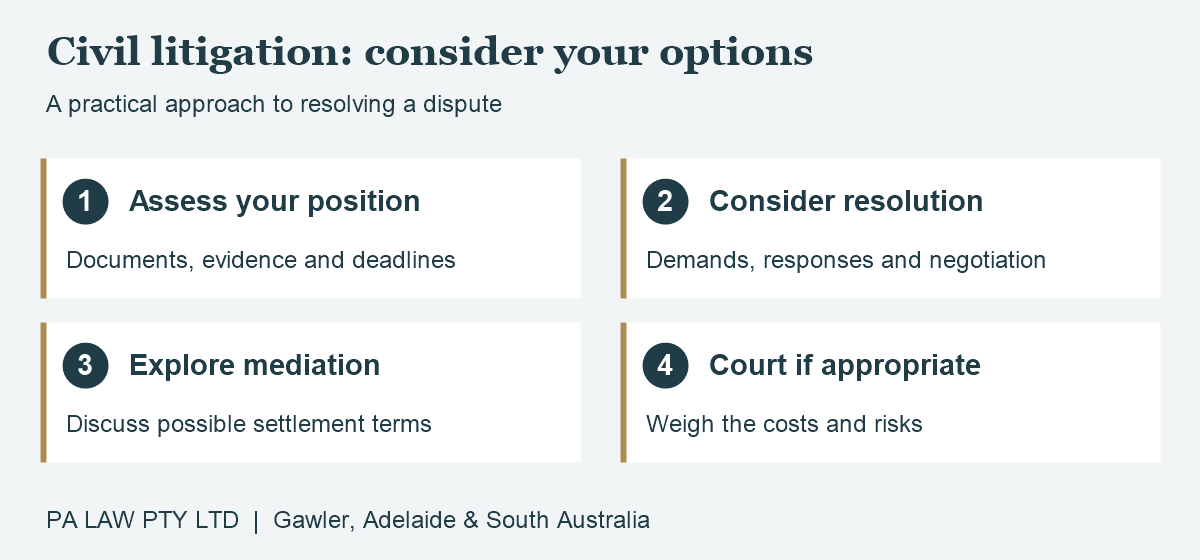
1. Understand your position and priorities
We start with your account of the dispute, the key documents and your desired outcome. We consider the legal issues, evidence, relevant deadlines and any immediate action required. Tell us about existing proceedings or a hearing date when you first contact us.
2. Consider a proportionate resolution
The next step may be a carefully prepared response, a letter of demand or a settlement proposal. We discuss whether negotiation is suitable and what a workable agreement would need to address, including payment dates, releases and what happens if an agreement is not followed.
South Australian pre-action requirements can apply before proceedings begin. The SA Courts guidance on steps before making a claim describes a final notice or letter of demand and a 21-day response period. The requirements for your matter should be checked before filing, particularly where urgent relief or a limitation deadline is involved.
3. Explore negotiation or mediation
Mediation gives parties an opportunity to discuss settlement with an independent mediator. It may help narrow the issues or resolve a dispute without a trial. A mediator does not decide who wins. We can discuss settlement options and help you understand proposed terms. Learn about mediation through the South Australian courts.
4. Proceed to court where appropriate
If settlement is not achievable, we can advise on commencing or defending civil litigation and the steps ahead. Depending on the case, these may include pleadings, disclosure of documents, directions hearings, evidence preparation and trial. We discuss representation where it is permitted and appropriate, together with the risks and likely costs.
Which South Australian court hears civil disputes?
The appropriate court or tribunal depends on the type of dispute, the amount claimed and the orders sought. The following is a general guide to monetary civil claims, rather than a rule for every dispute.
- Minor civil claims: generally claims of $12,000 or less in the Magistrates Court. Legal representation at trial is usually restricted, subject to exceptions. Advice and help preparing a case may still be useful.
- General civil claims: the Magistrates Court generally deals with monetary claims above $12,000 and up to $100,000.
- Larger or more complex claims: claims above $100,000 may be heard in the District Court or Supreme Court. The relief sought and costs consequences also affect the choice of court.
Some disputes follow specialist procedures or belong in a different forum. A Gawler address does not automatically determine the hearing venue. PA Law can advise on the appropriate process for your circumstances. See the SA Courts guide to starting a civil case.
Civil litigation costs, timing and the value of taking action
Before committing to civil litigation, compare the outcome you seek with the likely expense, time and risk. Legal fees are only one part of the picture: filing and service fees, expert evidence and enforcement costs may also arise.
PA Law can discuss the scope of the work and likely costs after learning about your matter. There is no single price or timetable that suits every dispute. An early settlement and a defended trial involve very different levels of preparation.
A court may order one party to contribute to another party’s legal costs. Winning does not necessarily mean recovering every dollar spent, and losing may expose you to an adverse costs order. Minor civil claims have different costs rules. The SA Courts information about legal costs explains why these risks should be considered before proceeding.
Making an informed decision about civil litigation
The right next step depends on more than whether you believe the other party is wrong. A useful civil litigation discussion brings together the legal position, the available proof and the practical outcome you need. These questions can help you prepare for advice and make decisions as your matter develops.
What evidence supports your account?
Start with the documents created when the events happened. A signed contract, an accepted quote, an invoice and a payment record may each explain a different part of the disagreement. Emails and messages can help show what was agreed, what was delivered and when concerns were raised. Keep the full conversation where possible, rather than relying only on selected screenshots.
A short timeline is often more useful than a long collection of unsorted material. Record the key dates, who was involved, what happened and which document supports each entry. Separate what you personally saw or heard from assumptions about another person’s intentions. If there are gaps or records you cannot obtain, identify them so they can be discussed.
Tell your lawyer about documents that may weaken your position as well as those that support it. Early advice is more useful when it is based on a complete picture. Do not alter original records, and keep copies of documents sent to or received from the other party.
What would a workable settlement look like?
Think about your priorities before making or accepting an offer. You may want payment, completion of agreed work, an end to a business relationship or certainty about future obligations. The amount offered is important, but timing, practical performance and the scope of any release can also affect the value of a settlement.
For example, an offer to repay a debt in instalments raises questions about payment dates, the duration of the arrangement and what happens if a payment is missed. An agreement to resolve a contract dispute may need to identify the work still required, who will do it and how completion will be confirmed. These details should be considered before you sign.
Ask whether a proposed settlement resolves all relevant issues or only part of the dispute. Check who is bound by the agreement, how costs are addressed and whether further documents or court steps are needed. Obtain advice on the actual wording rather than assuming a brief exchange of emails covers everything you intended.
Is the next stage proportionate to the outcome?
Civil litigation decisions should be reviewed as the evidence and costs become clearer. An approach that made sense at the start may need to change after a response, a new document or a settlement proposal. Consider what further work is needed, what uncertainty remains and whether the likely benefit justifies proceeding.
It can help to identify a realistic range of outcomes and your priorities within that range. Consider the time you will spend locating documents, giving instructions and attending appointments or hearings. For a business dispute, also think about interruptions to normal operations and the effect on an ongoing commercial relationship.
PA Law can discuss the available legal options and their practical implications. You remain involved in deciding how to proceed, with advice tailored to the facts of your matter. A decision to negotiate, defend a claim or pursue payment should be based on your circumstances and the evidence, rather than an assumed guarantee of success.
After settlement or a civil litigation judgment
Reaching an agreement or obtaining a judgment is an important stage, but further steps may be needed. Keep a clear record of the terms, payment dates and any outstanding obligations. Retain receipts and correspondence showing what has been paid or completed, and seek advice if the other party does not follow the agreed arrangement.
If a judgment debt remains unpaid
A court judgment requiring payment does not automatically collect the money. Depending on the circumstances, the creditor may need to apply for an enforcement process. The correct option depends on the order already made, what is known about the debtor and whether the relevant requirements can be met.
The South Australian courts describe an investigation summons as a process for examining a judgment debtor’s ability to pay and how payment may be made. Other enforcement procedures have their own requirements. PA Law can advise on the options relevant to your judgment and the likely cost of taking another step. Read the SA Courts guidance on enforcing a civil debt.
Bring the judgment, details of payments received and any correspondence about payment to your appointment. If you are the person required to pay, obtain advice promptly about the order and your circumstances. Keep track of deadlines and do not assume that difficulty paying makes the order disappear.
Our civil litigation assistance includes advice about enforcement where appropriate. The amount still outstanding, the information available about the other party and the practical prospects of recovery should all inform the next decision.
What to bring to your first consultation
A clear set of records helps make the discussion more useful. Where available, gather:
- The agreement, terms and conditions, variations and relevant guarantees.
- Invoices, payment records and a calculation of the amount in dispute.
- Emails, text messages, letters and any settlement proposals.
- Photographs, reports or other evidence relevant to the disagreement.
- Court documents, notices and any hearing or response dates.
- A short timeline, the other parties’ names and the outcome you would like.
Keep original records and avoid deleting relevant messages. If you do not have every document, contact us to discuss what is needed. Mention any urgent deadline at the outset.
Civil litigation lawyers for Gawler, Adelaide and SA
PA Law Pty Ltd is based in Evanston South and assists clients in Gawler, Adelaide and throughout South Australia. Appointments are available by arrangement, with telephone and Microsoft Teams consultations where appropriate. You can discuss how best to provide documents and arrange an appointment when you contact us.
We focus on clear explanations and an approach suited to your circumstances. Read about PA Law or browse our legal services. If your dispute concerns provision from a deceased estate, our contesting a will page covers that separate area.
Civil litigation FAQs
What is civil litigation?
Civil litigation is the process of resolving a non-criminal legal dispute through the courts. It can involve unpaid debts, breaches of contract or business disagreements. Legal advice may also help resolve the dispute before a claim is filed or a trial becomes necessary.
Do I have to go to court to recover a debt?
Not necessarily. A demand, repayment arrangement or negotiated settlement may resolve the matter. If those steps are unsuccessful, court action may be considered after reviewing the evidence, relevant requirements and the practical prospects of recovery.
Can a lawyer represent me in a minor civil claim?
Representation at a minor civil trial in South Australia is usually restricted, with exceptions. You can still seek advice about your position and preparation. Ask whether representation is permitted in your particular matter before assuming a lawyer can appear at trial.
What should I do if I receive a court claim?
Read it promptly, preserve the documents and note the date of service. Obtain advice about the applicable deadline and whether to defend, negotiate or take another step. Ignoring a claim can lead to a default judgment. Do not assume that contacting the other party extends the deadline.
How long do I have to start a claim?
Limitation periods depend on the claim and its circumstances. There may also be notice requirements and contractual time limits. Seek advice early so the relevant dates can be assessed; do not assume that negotiations preserve your right to sue.
How much will my dispute cost?
The cost depends on the issues, evidence, amount of work and whether the dispute settles or proceeds to trial. Contact PA Law to discuss your circumstances, the proposed scope of assistance and likely costs before deciding how to proceed.
Will I recover my legal fees if I win?
Not necessarily in full. Costs orders depend on the court, the type of proceeding and the circumstances. Any amount recoverable may be less than your actual legal fees. The other party’s ability to pay is also relevant to the value of pursuing a claim.
Can I speak to PA Law if I live outside Gawler?
Yes. PA Law assists clients in Adelaide and across South Australia as well as Gawler. Telephone and Microsoft Teams consultations are available by arrangement where appropriate. Contact us to discuss your matter and appointment options.
Take the next step towards resolving your dispute
Speak with PA Law about your civil litigation, debt recovery or contract dispute. Tell us briefly what has happened and whether you have received a demand, court claim or hearing notice.
Call 0431 614 696 · Arrange an appointment
manal@palaw.au
PA Law Pty Ltd · Evanston South, South Australia
General information only, not legal advice for your circumstances. Court procedures and time limits should be checked for your matter. Liability limited by a scheme approved under Professional Standards Legislation.